What’s driving the surge in transnational crime?
It’s not just greed — it’s the convergence of globalization, economic disparity and technological innovation. These forces allow criminal networks to expand across borders, exploit vulnerable populations and move faster than law enforcement. Understanding these drivers is key to disrupting them.
Globalization
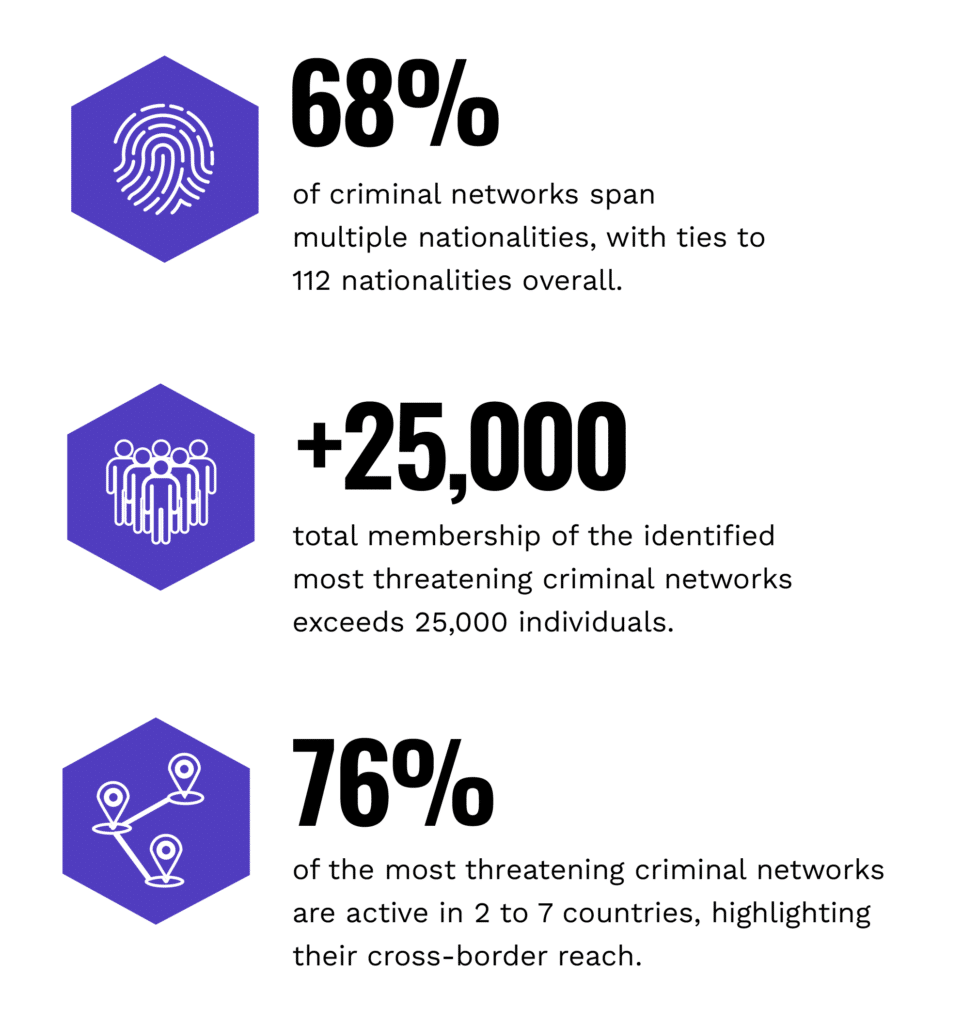
Globalization has enabled criminal networks to expand across borders with greater speed and efficiency. The rise of global trade, financial liberalization and digital communications has made it easier for these groups to move goods, money and people, while exploiting gaps in jurisdiction and regulation. Europol reports there are 821 criminal networks that currently operate in or impact all 27 EU member states. Sixty-eight percent of these networks include members from multiple nationalities, with ties to 112 nationalities overall. These groups are not isolated. They are interconnected, multinational ecosystems. Europol describes this as a shift toward “borderless” organized crime: criminal activity that spans multiple jurisdictions and touches many countries simultaneously. In fact, 76% of the most threatening networks are active in two to seven countries, indicating how geographic boundaries no longer limit the reach or structure of organized crime.
Real-world examples show how globalization and cross-border collaboration are reshaping transnational crime networks:
1. Cross-Border Drug Trafficking: The rise of global trade has enabled drug cartels to expand their operations across multiple countries. For instance, Mexican cartels collaborate with European and Asian criminal groups to smuggle narcotics worldwide, exploiting gaps in international law enforcement.
2. Cybercrime Groups: Globalization has enabled cybercriminal organizations like Russian-based Evil Corp to operate across borders with ease. These groups use advanced ransomware attacks to target businesses worldwide, exploiting global financial systems and cryptocurrencies to launder illicit funds while evading law enforcement.
Economic Disparities
Economic inequality is a major driver of transnational organized crime. In regions where poverty is widespread, legitimate employment is scarce and public services are weak, criminal networks exploit vulnerable populations — offering income, protection and a sense of belonging. The United Nations Office on Drugs and Crime (UNODC) 2023 World Drug Report highlights how social and economic disparities fuel and worsen drug-related challenges. Youth and marginalized communities are especially at risk of recruitment into trafficking, smuggling and cybercrime as a means of survival. Desperation also drives demand for black-market goods and services, from counterfeit medicine to illicit migration routes. These conditions are often compounded by weak governance, corruption and political instability. Criminal organizations and transnational gangs thrive in environments where institutions are under-resourced or compromised, using bribery and intimidation to bypass enforcement and extend their control over borders, trafficking routes and even local economies. Together, economic hardship and fragile state structures create fertile ground for organized crime to grow, entrenching cycles of exploitation and insecurity across borders.
Technological Innovation
Criminal organizations are fast adopters of emerging technologies like AI, cryptocurrencies, drones and messaging apps. These innovations not only enhance their efficiency but also overwhelm traditional law enforcement methods. The same AI technologies that help cyber security teams defend against cyber threats, are also weaponized by threat actors to automate attacks, exploit vulnerabilities and launch sophisticated phishing, ransomware and influence campaigns. GenAI is accelerating cybercrime, making it easier for criminals to execute, faster to scale and harder for law enforcement to trace. But it’s not just the attacks themselves that are developing — so are the ways criminals communicate and coordinate. Encrypted platforms, for example, pose a major challenge. The takedown of the ‘Ghost’ communication platform revealed how organized crime networks use encrypted tech to coordinate cross-border crimes like drug trafficking and murder.


Comments
Post a Comment